Generative AI Video: From Product to Infrastructure
The demo era is over. As AI video settles into the base layer of the business, here's what changes for you, wherever you sit in the value chain.
The past few weeks have been unusually busy for AI video. Kuaishou's video-generation arm Kling was in talks to raise big money at a valuation near $18B, with spin-off and IPO chatter attached. Video-understanding company Twelve Labs raised about $110M and said it would optimize inference on AWS Trainium. SK Telecom and KAIST's video-compositing work was accepted at a major conference and is already running on air as virtual product placement. Google shipped a model that costs $0.034 per 1,000 images, and NotebookLM began turning source material into 60-second vertical videos.
Taken one by one, they're just separate headlines. Put together, they rhyme. The stage where people gathered to marvel is ending, and money, compute, and production workflows have moved in behind it. That's the classic sign of a technology going from a spectacle to something you use every day. AI video is settling from product into infrastructure.
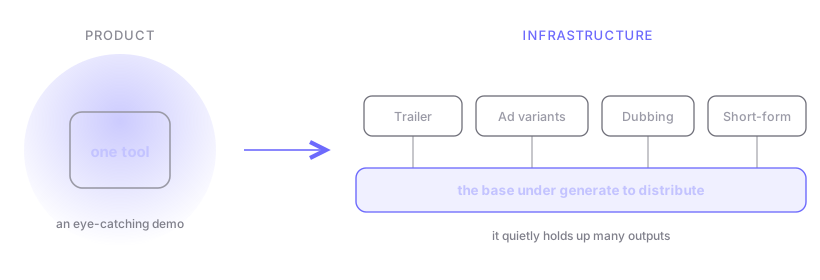
Where the game is actually won
Lump AI video together as "the thing that makes videos" and you'll miss the shift. Split it by what it does: generation that makes new footage, retrieval that finds what you already have, insertion that composites objects and people onto real footage, and distribution that pushes results out in the right format.
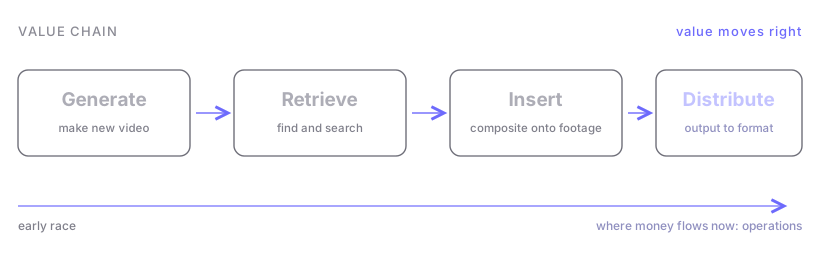
Early on, everyone crowded into the first layer: how convincing a single shot you could produce. But on a real set, generation isn't the bottleneck. Finding the footage, organizing it, blending it invisibly with what you shot, and pumping it out to every channel's spec is far more tedious and expensive. That's why the money is bleeding toward retrieval, insertion, and distribution. Value now comes from running the whole chain, not from one gorgeous cut.
Why now
An idea only moves an industry when the conditions line up, and three just did. Models matured enough to produce not one stunning frame but a hundred consistent ones on demand, which is what a set actually needs. Generation costs collapsed, so effects you used to ration became something you spray from first draft to ad variant. And vertical short-form hardened into a standard, so it's clear what is worth automating. When you know what to make, automation finally earns its keep. A team that used to spend days on a single ad mockup now wakes up to dozens and starts by choosing. Once the expensive becomes cheap, the axis of competition moves too: not what you can make, but how fast and how much you can try. Investment pools where those three overlap.
Wherever you sit in the value chain
This lands differently on different people. On one side costs fall; on the other, assets appear that weren't there before. What matters isn't someone else's seat but which part of yours shakes first.
| Your seat | What changes | What to handle now |
|---|---|---|
| Studios, production houses | Post time and cost drop; review load fills the gap | Set your filtering bar before your output volume |
| Directors, creators | Work moves from pixels to judgment | Build a feel for what to prompt and how far to allow |
| Agencies | An actor's face and voice become a managed, sellable asset | Pin consent scope and reuse terms in the contract, and open a new revenue line |
| Platforms, broadcasters | The archive turns from cost into asset | Get good at searching and reselling well-kept originals |
| Brands, advertisers | Placing a product ends in post, not on set | Watch the naturalness of the insert and the approval flow, not just ad slots |
| Tool, infra vendors | The game moved from single-shot quality to running the chain | Make your money in retrieval, insertion, and review, not just generation |
Underline it in one line: wherever you sit, the weight shifts from making toward choosing, blending, and protecting. And who wins isn't who flips the tool on first, but who bakes that shift into how they work.
Still a helper, not the author
None of this means it's done. Generated video still wobbles over any real length. Push past a few seconds and faces, clothes, and spaces drift; objects break physics, vanishing and overlapping. Keeping the same character identical across scenes is still expensive. The details a human eye is picky about, hands and text, reflections and shadows, still fall apart often.
So the realistic use today isn't an end-to-end finished piece but a helper that assists, extends, and alters what you shot. It's strong at filling backgrounds, stretching a scene, and switching formats, and still weak at inventing a story on its own. How fast that weakness narrows will decide how deep AI video reaches into the pipeline.
Rushing the call costs you on both sides. Overrate it and cut people too soon, and you lose the hands that catch the breaking details; underrate it and stall, and you miss the gains of cheap automation. What's needed now isn't the nerve to switch on a tool but the judgment to draw a line between where people stay and where automation takes over.
The homework: rights, trust, cost
It won't be smooth. It grinds in three places.
Rights move from "what did it train on" to "how was that data obtained," and then to "aren't the rightsholders using AI too." The authors' suits and the studios' fights dig less into whether outputs look alike and more into where the data came from and what the contracts say. Makers can no longer just check that a result doesn't resemble someone else's. What you trained on, where you got it, and whether you can write that trail into a contract is what separates risk from safety.
Trust becomes a matter of treating an actor's face and voice as assets. A late actor's voice was revived with consent; actors and influencers are scanned in high resolution and kept on file. Cloning has crossed from a shield you hold to an asset you run. Writing down the scope, term, and reuse conditions of consent is what trust actually is. One slip here and the relationship with the actor and the brand image both collapse at once. What separates an incident isn't whether the tech works but how far the agreement went.
Cost turns into a price war. A few cents a frame isn't a price for one finished piece; it's a price that tells you to spray hundreds and see. The cheaper it gets, the more the bottleneck moves from making to choosing. The question stops being what you can make and becomes which of the flood you'll ship. So the next cost lands on people, not the generator. The team with the eyes and the process to filter the flood is the one that actually banks the savings.
So
The next round is decided inside the pipeline, not on screen. An eye-catching shot becomes common fast. The edge goes to whoever runs the make, find, blend, and ship chain reliably. Over the next year, watch how much further generation costs fall, how tightly video retrieval bolts onto real editing tools, and where contracts and case law draw the line around actor cloning and training data. Infrastructure arrives quietly. What isn't quiet is the gap between those who prepared and those who put it off, and that gap opens not one day out of nowhere but in the months you spend now fixing contracts, archives, and review.