AI Music Is Getting Tagged. Nobody Can Answer the Question
The global recording industry agreed to tag tracks made with AI, and a declaration field showed up on distributor upload screens. It asks whether you sent the master to a web service and whether a chatbot wrote the first draft of the lyrics, and almost nobody remembers. Across five major Korean music services the question is asked three different ways, and three of them do not ask at all. We followed one checkbox down the distribution chain.
Anyone who has taken a release through a distributor knows the upload screen. Artist name, album title, release date, genre, contributor credits, cover art specs. Dozens of fields waiting to be filled.
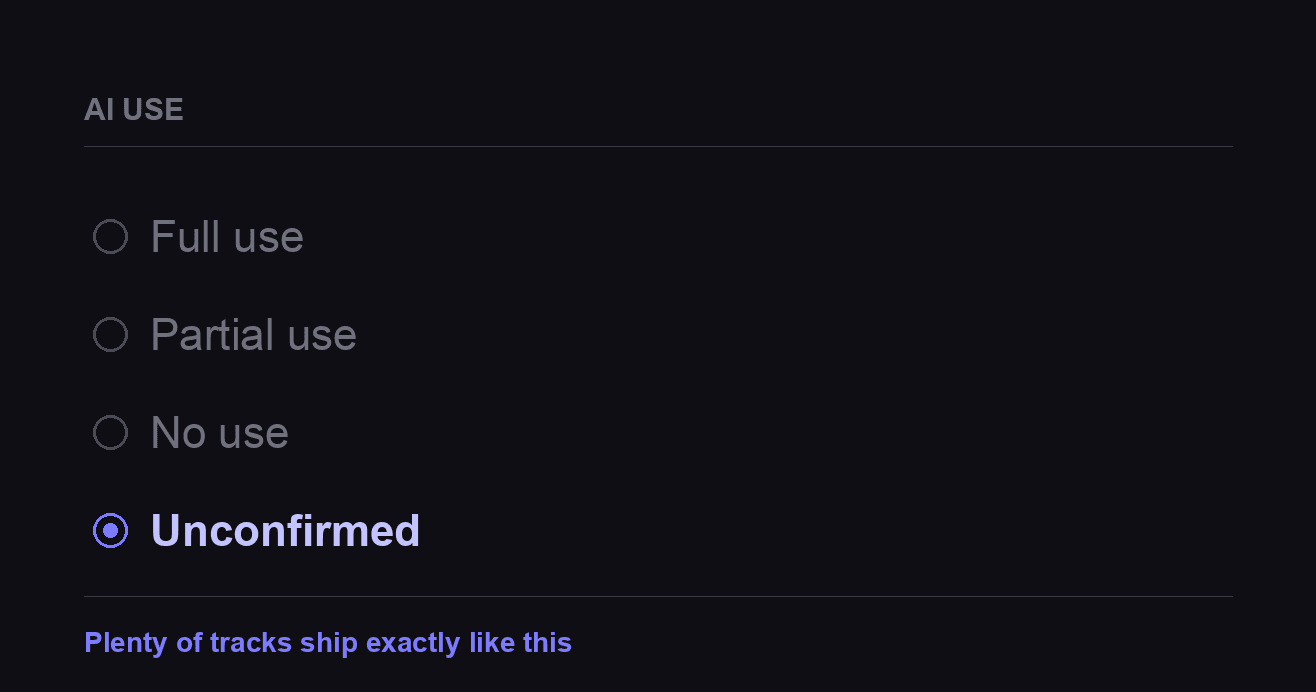
Since last year distributors have added one more. It asks whether AI was used, and it splits the question apart: vocals, instruments, composition, post-production, lyrics.
It looks like a field you skip. But what you pick here decides how every downstream platform handles that track, and last month the industry started turning it into a formal standard.
If you release through a company there is at least someone to ask. If you make the record alone in a room and upload it yourself, there is nobody, and you are left trying to remember what tools you touched six months ago.
The RIAA and IFPI put out a labeling scheme
The RIAA is the Recording Industry Association of America, the trade body for labels like Universal, Warner, and Sony. The IFPI is its international counterpart, representing the recorded music business across some seventy countries. When those two move together, it amounts to a decision by the global industry.
On July 10 a coalition led by both bodies announced a voluntary labeling scheme for tracks made with generative AI. Two badges, "AI generated" and "AI assisted," go into the metadata and surface next to the track on Spotify, Apple Music, Deezer, and Tidal.
The coalition left it up to each party whether to apply a label and wrote in no obligation. What it did instead was add one more field to DDEX, the metadata format the music business has used for close to twenty years to pass track information between distributors and streaming platforms. Rather than laying a new road, they bolted a field onto the one everyone already drives.
At the announcement the head of the RIAA said artists who want to use AI should be able to, and that saying so when you have is better for the people who use it and the people who do not.
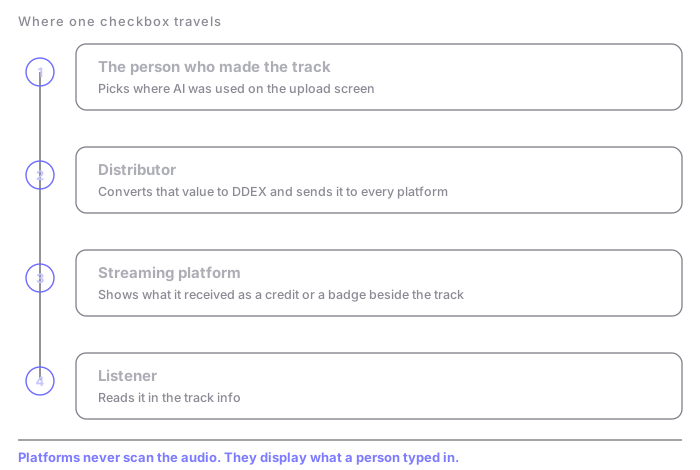
One point is worth pinning down. Platforms do not scan the audio and work out whether AI was involved. They read the value a person typed in and display it.
The person who made the track enters it, the distributor passes it along untouched, and the platform shows what it received. Everything that follows comes out of that order.
What the pipeline actually looks like
Whichever distributor you use, the shape is the same. The distributor converts your uploaded track into DDEX and sends it out to each platform. Before the standard existed, every platform wanted a different format and distributors had to match them one by one.
In late 2025 DDEX published an extension that adds a field for declaring AI involvement to the existing standard. Major labels, distributors, and streaming platforms built it together.
Spotify adopted it in September 2025. Instead of developing detection technology in-house, it took the industry format and split the field into five: AI vocals, AI instrumentation, AI composition, AI post-production, and AI lyrics.
Spotify's reasoning was that AI use runs along a spectrum and that artists and producers drop AI into several points in a workflow. Rather than cutting a track into AI or not-AI, the standard takes a declaration granular enough to name the stage. Once content providers start sending the metadata, Spotify said, it will surface it across the service over time.
In practice the order runs like this. The creator uploads a track to a distributor. During upload the distributor presents the AI declaration in some form, as a checkbox in some places, as a question during release review in others, and in a few cases still as a free-text note. The distributor turns the chosen value into a metadata field, attaches it to the release, converts it to DDEX, and ships it to each platform.
There is no separate filing to do at every platform. Get it right once at upload and every platform downstream takes that value as given.
Apple Music followed. It notified labels and distributors of a policy change adding transparency labels to AI-generated music. Not just the audio: lyrics, music videos, and album artwork count too if AI made them, and the policy applies to new releases.
Tidal went a step further and wired the AI label to royalty eligibility. There, this one flag reaches into how a track gets paid.
Nobody wrote it down
That is the story from the standards side. The place where people preparing a release actually trip up is somewhere else.
To declare it you first have to know, and almost nobody kept the record. Lay out the questions waiting at the upload screen and it becomes obvious why the answers stall. Did a generative tool make the first pass at the arrangement? Did the mix engineer run a stem separation tool? Did the master go to an AI service? Were the backing harmonies synthesized? Did the lyrics start as a language model draft that got rewritten?
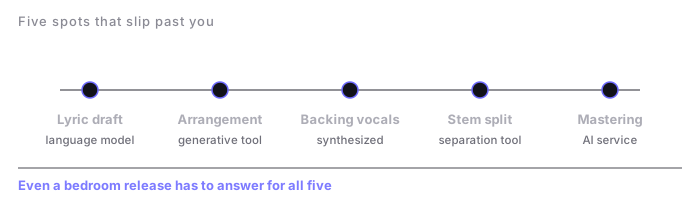
For a company release, the person who knows is usually a freelancer. Nobody put it in writing and nobody added a line to the contract. One phone call would produce the answer, and nobody has made that call.
Working alone is a different problem. You are the only person who knows, and you cannot recall which plugin you loaded half a year ago. Whether the web service that mastered the track ran AI under the hood is something you never checked at all.
In our report on agent adoption we wrote that rights information does not live only in contracts and systems but is scattered across habit, verbal agreement, and one person's memory. AI usage history is worse. Nobody ever thought of it as something to record.
So the habit of writing it down while you work matters more than learning the standard. If the question has no answer at release time, the answer has to be captured during production. Working with freelancers, put a line about AI disclosure in the work order. Working alone, drop a note file into the project folder.
Nobody defined what partial means
The people who wrote the standard left some things open. The DDEX field is optional, and you can leave it blank. Which model you used and whose tool you ran are not required either. Above all, nobody set a boundary for what "partial" covers.
So a track where an AI tool touched only the master and a track whose entire arrangement came out of a generative tool land in the same box. With no criterion, every company fills it in differently, and a few years from now anyone who gathers this data will be holding values that cannot be compared.
Where does someone land who pulled a skeleton out of Suno or Udio and sang the vocal themselves? The standard has no answer, and there are already plenty of people uploading tracks made exactly that way every week.
Right now the whole thing runs on the maker's word. It is closer to handing in a one-page form alongside the audio saying, here is how we made this. Because the form and the file travel separately, skipping it or filling it in wrong leaves nothing in the audio to catch it.
That is why there is also a push to embed the marking in the file itself. C2PA, which caught on first in photo and video, attaches who made something, when, and with what, directly into the file, so opening the track brings its history along. ISCC takes a different angle and derives a short fingerprint code per track, which means the same song reuploaded under a dozen different titles still collides on the code.
Adoption in music is thin for both. For a while yet, a value typed in by hand is the only thing to go on.
Only honest people declare
The scheme carries a large hole from the design stage. Self-declaration means only those inclined to disclose will disclose, and the operators this standard was built to address have no such inclination.
Self-declaration cannot filter out the outfits mass-uploading AI tracks to siphon royalties. The industry puts the losses those operators inflict on artists at around two billion dollars a year. Deezer said 70% of the streams it flagged as fraudulent were fully AI tracks.
Spotify has removed 75 million spam tracks. But removal requires detection first, and detection is not something self-declaration does for you.
The upshot is that the labeling standard adds work for the diligent while the parties causing real harm carry on untouched. That does not make it pointless. As honest declarations accumulate, the tracks with nothing declared stand out by contrast, and detection can then be aimed at a much narrower band. Until that point, though, the cost sits with the people who declare.
Does declaring hurt you?
If you have a release coming, this is the first thing you want to know. Say you used AI, and do you slide down the recommendations or lose reach?
Spotify stated flatly that it will not penalize or downrank music for being AI-assisted. The intent, it said, is to let artists share their process consistently across the service without worrying that doing so costs them promotion.
And if you say nothing? A missing or false declaration can delay the release, pull the track down, and drag recommendation reach with it. If you cloned somebody's voice or likeness you need explicit documented permission from that person, and labels are expected to keep written records of where AI was involved.
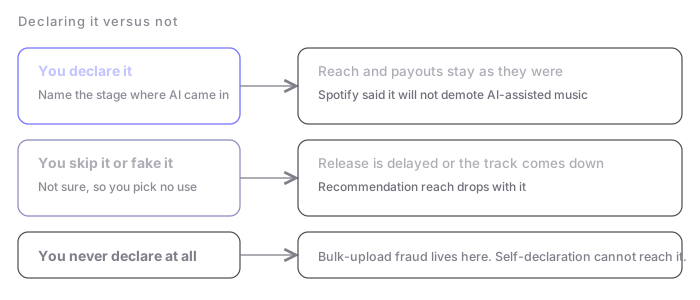
Anyone making tracks with AI hesitates longest here. Pick full use and it might sink, so the hand drifts toward no use. Going by the policies published so far, though, what you lose by declaring honestly is far smaller than what you lose when a concealed declaration surfaces.
Korea has a gap
For anyone releasing in Korea this part bites hardest. The Korean AI Framework Act places no obligation on music services to handle AI music separately, because the transparency duty attaches only to the companies building the composition AI. Set against the EU AI Act, which splits obligations across providers, deployers, and distributors, commentators have noted that the blind spot flagged before the law took effect is now real.
The absence of a distribution-stage duty in Korean law does not leave Korean releases free. A Korean release lands under Apple Music and Spotify policy the moment it goes out to them. Foreign platforms have filled the space Korean law left alone through their terms of service, and practitioners are already working to that standard.
Korea has split three ways
While the legislature has left distribution alone, some operators built the field themselves. Checking five major Korean music services turns up three different approaches even among the ones that built it.
| Type | What it asks | Carrying it abroad |
|---|---|---|
| Asks the stage | Which of vocals, instruments, composition, post-production, or lyrics | Carries over intact |
| Asks the degree | Full use, partial use, no use, or unconfirmed | No rule for translating it |
| Does not ask | No field at all | Nothing to carry |
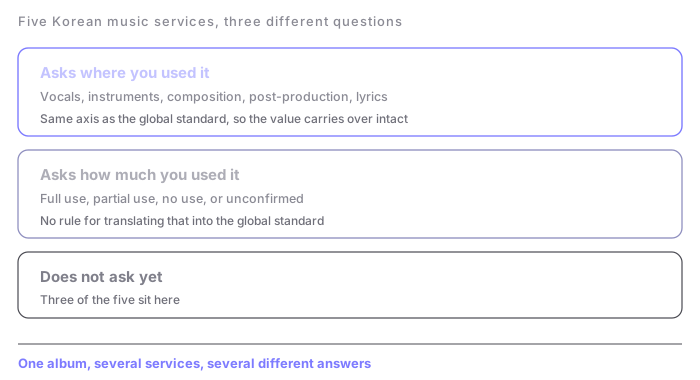
The services asking which stage use the same axis as Spotify and Apple Music, so the value they collect travels abroad unchanged. The service asking how much uses a different axis entirely. A track where AI touched only the master gets logged there as partial use, and nobody has decided which of DDEX's five categories that value maps onto. The unanswered question of where partial ends plays out a second time, this time between Korea and everywhere else.
Three of the five do not ask, and those happen to be where more listeners are. Someone releasing only in Korea never encounters the field at all, right up until the same track goes out internationally.
The result is that one album put out across several Korean services collects several different answers for the same song. One asks which stage AI touched. Another asks how much of it was AI. The remaining three have no field to fill. Anyone who tries to measure the share of AI music in Korea a few years from now will be handed several incompatible datasets.
Worth a closer look at the screen from the service asking how much.
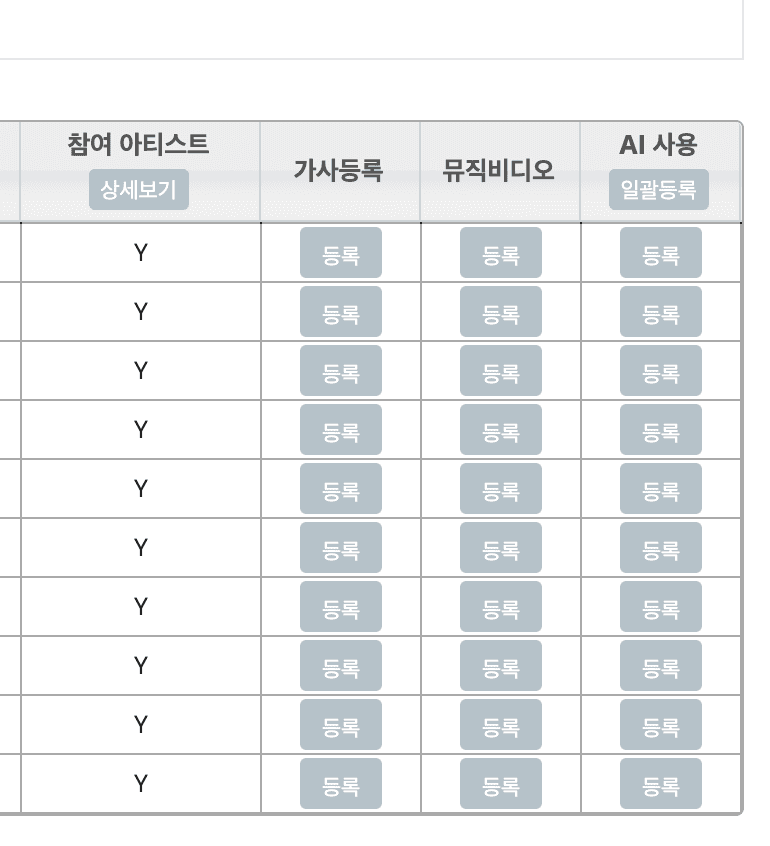
In the release list, the AI use column sits right alongside lyric registration and music video, with a bulk-register button under the column header and a register button on every row. The service treats it as the same class of item as lyrics or a video.
Clicking register opens the AI use panel.
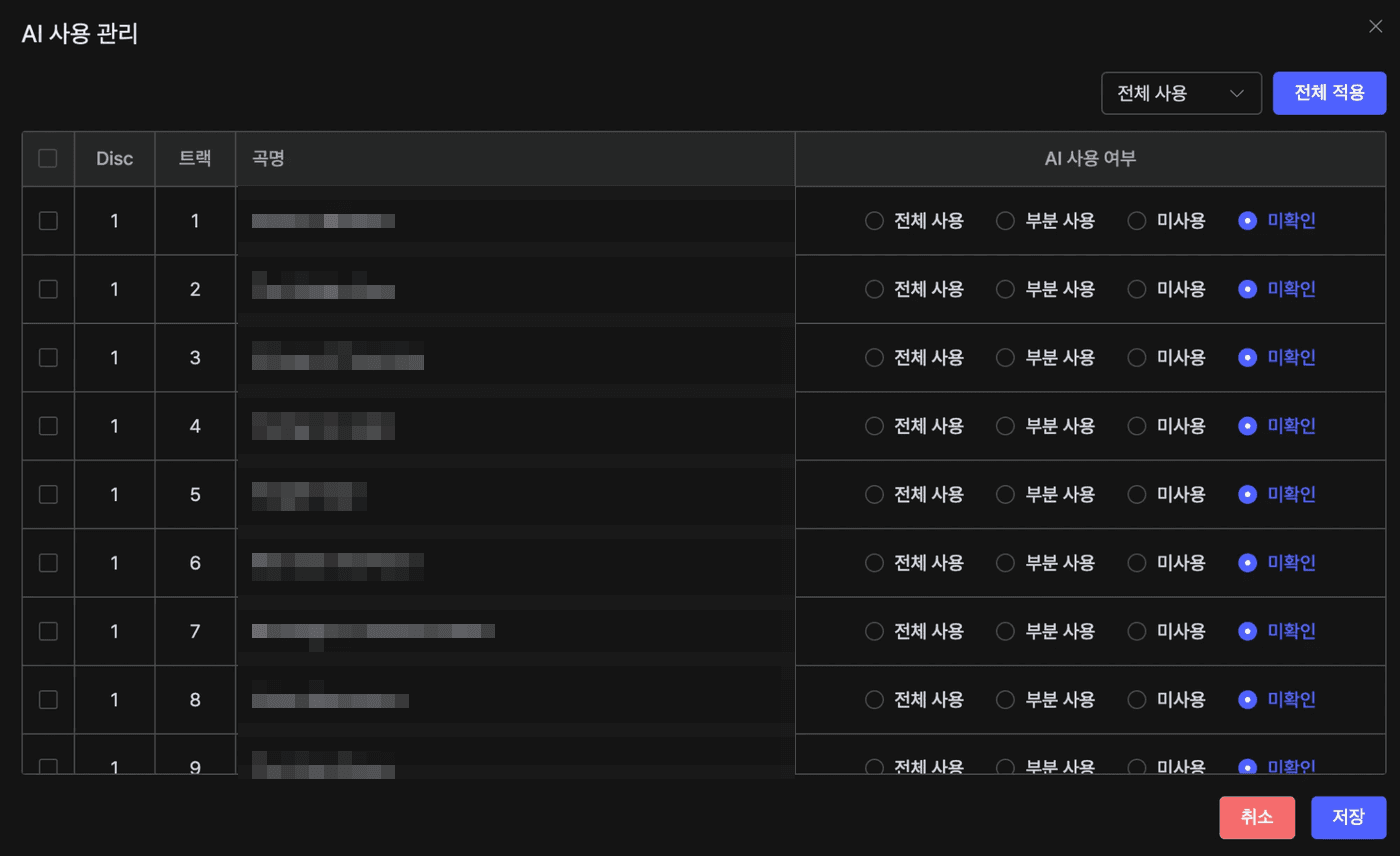
The panel asks per track. Disc and track numbers run down the rows and the value is chosen song by song, so this is a step beyond hanging a single value on the whole album. That matches the direction DDEX took.
What stands out is the default. All ten tracks open with the dot sitting on unconfirmed. Whoever built the screen already assumed the person uploading would not know.
Top right there is a dropdown and an apply-to-all button. One click pushes the same value onto every track, and the bulk-register control on the list screen does the same job. Anyone without records reaches for that button first. Push all ten to no use, hit save, and as far as the screen is concerned the filing is done.
What to do from where you sit

Releasing on your own. Starting with the next track, keep a note file in the project folder. Which plugins, which web services, one line each is enough. It beats sitting at the upload screen six months later trying to reconstruct it. If a web service mastered the track, find out now whether it runs AI. Plenty of services do without AI anywhere in the name.
Making tracks with AI. Keep separate track of how far the generation went and where your own hands started. Pull a skeleton and finish it yourself and the box you pick changes. Ship what you generated as-is and it changes again. If you referenced somebody's voice or vocal style you need documented permission, and that is the item most likely to bite you under the current rules.
Handling releases at a label. Add one question to the production process before the next release: get written confirmation from freelancers on where AI was used in the track. One extra line on the work order and the invoice covers it. And do not push ten tracks through the apply-to-all button. Once it saves, unwinding it later is hard.
Your back catalog becomes a problem eventually too. The day retroactive declarations get asked for, there will be no way to reconstruct old sessions. What you can pull out then is only what you start keeping now.
Releasing internationally. Preparing to the Korean bar is not enough. Apple Music looks at lyrics, music videos, and album artwork on top of the audio. Cover art from a generative tool is a declarable item. None of that gets asked about on a domestic release.
Building AI music tools. Tell users which declaration category their output falls into. That one line of guidance turns into a feature people pay for. Make generation history exportable as a file and users will carry it straight into distribution. Almost no tool does this today.
Start with the track you are making now

The standard takes a day to learn. Writing things down while you work is the harder half and the one that matters, because without it there is no answer to give at the release screen.
Tracks already out are close to unrecoverable. If retroactive declarations arrive, there is no way to establish who mastered a record three years ago or how. So the place to start is the track on your desk right now, and the work amounts to a note in the project folder and one more line on the work order.
That checkbox gets clicked by the person who made the track. Skip the note today and you will be guessing again when the time comes.
Read next

Previz Comes After the Prompt
Three things landed in the first week of September. GPT-6 Astra built a house in Blender and moved it into Unreal, Higgsfield bolted a 3D workspace on top, and Images 2.5 got better at holding a reference image steady. String them together and the order of AI video production changes. Here is what is confirmed and what is still a vendor claim.
The AI That Never Leaves the Building
Unreleased masters, raw footage, next week's pitch deck. Plenty of companies stall on AI because those files cannot go up to somebody else's server. Here is what one machine in your own office can and cannot do today, and where it lands a year from now.

We Asked AI About Our Artists
Ten K-pop teams, four questions each, four conditions, 280 responses checked against a verified answer key. Error rates ran from 3.8% to 40%. The widest gap turned up inside a single model: whether it was connected to search mattered more than which model it was.